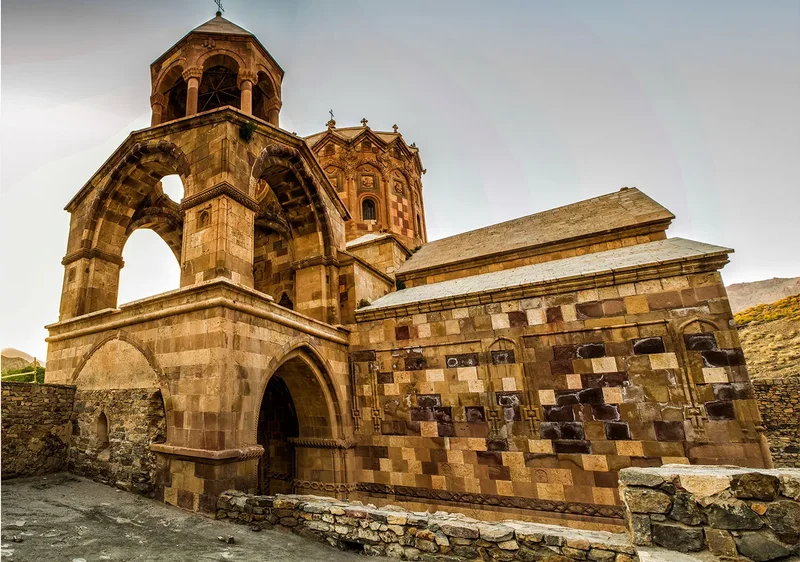
Qara Kelisa
Qara Kelisa, the Monastery of St Thaddeus, is one of the oldest Armenian pilgrimage sites in north-western Iran. Black and white stone churches, carved façades and the annual pilgrimage preserve its living religious importance.
Northwest Iran, Lake Urmia and border highlands
Armenian monasteries and the legacy of Takht-e Soleyman
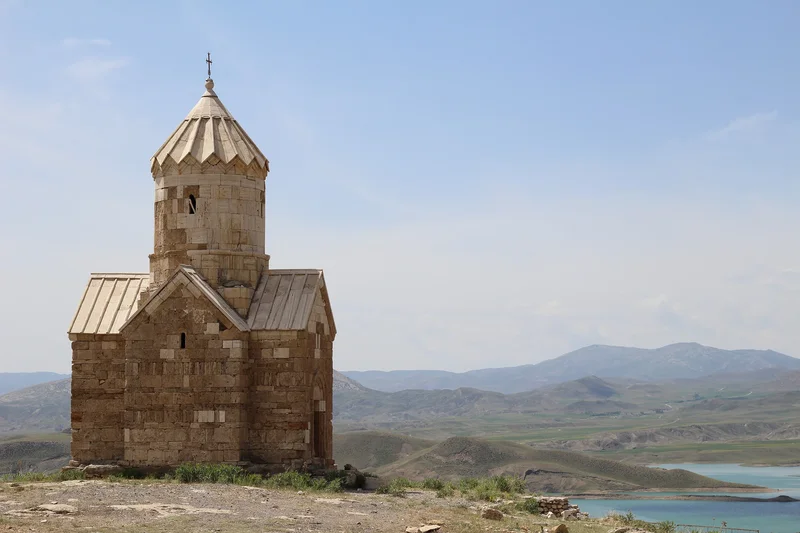
Along Iran’s northwestern borders, West Azerbaijan brings together several historical and religious traditions. Takht-e Soleyman’s Sasanian architecture and sanctuary remains, alongside St. Thaddeus Monastery and Dzordzor Chapel, anchor the province’s heritage routes.
The Urmia plain, Maku’s rocky valley and the mountains around Takab offer contrasting scenery. Lake Urmia is an important, environmentally vulnerable part of this landscape. Urmia and Khoy’s markets add local food, crafts and everyday life to a journey between monuments.
05
Qara Kelisa, the Monastery of St Thaddeus, is one of the oldest Armenian pilgrimage sites in north-western Iran. Black and white stone churches, carved façades and the annual pilgrimage preserve its living religious importance.
Lake Urmia is a vast hypersaline lake in north-western Iran. High salinity, islands and dramatic changes in water level create a unique yet vulnerable ecosystem supporting brine shrimp and migratory birds.
On an oval platform amid volcanic mountains, Takht-e Soleyman brings fire, water and royal power into a single ensemble. An artesian lake, the principal Zoroastrian fire sanctuary, a temple of Anahita and Sasanian palaces embody some 2,500 years of sacred history. The site has been on the World Heritage List since 2003.
Urmia Bazaar is a brick-built covered commercial complex in the historic centre. Its lanes, caravanserais and craft sections recall Urmia’s position at the intersection of routes linking Iran, Anatolia and the Caucasus.
In Khoy, a mausoleum attributed to Shams-e Tabrizi stands beside a historic tower associated with Shah Ismail Safavi. Ram horns and hunting trophies embedded in its brickwork create an unusual image of Safavid power and taste. The site holds particular appeal for those interested in Rumi, Sufism and the history of Iran’s great routes.
Turkic-speaking, Kurdish and Christian communities share parts of the province, contributing to varied local traditions. Markets, mosques and churches offer different perspectives on this cultural and religious heritage.
Urmia’s Seh Gonbad tower and the Shams Tabrizi monument in Khoy are other historic visits, separate from the World Heritage properties.