Old City of Yazd
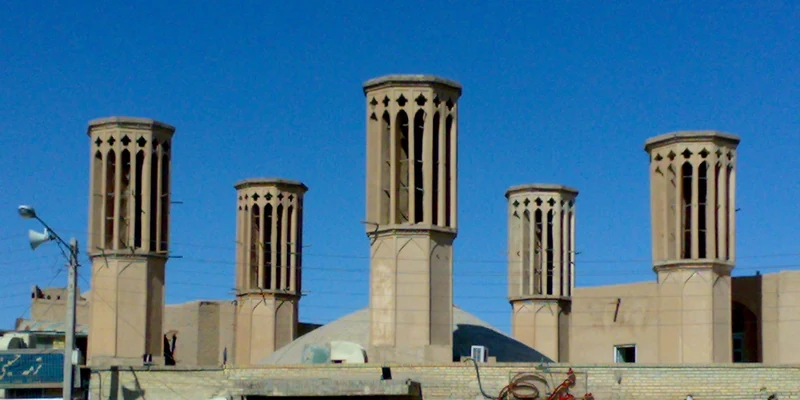
Follow Yazd’s covered lanes to see a desert city thinking through shade, air and water. Earthen buildings, windcatchers and qanats make climate adaptation part of the streetscape rather than an abstract idea.

Central Iranian Plateau
An earthen city beneath the windcatchers
Walk Yazd’s covered lanes to see how earthen houses, windcatchers and qanats respond to heat and scarce water. The historic city is still inhabited, with Muslim, Zoroastrian and Jewish religious spaces alongside everyday urban life. Its architecture makes more sense when seen as part of a working city.
Beyond Yazd, visit Meybod for adobe monuments and zilou weaving, Mehriz for gardens and Taft for foothill settlements. Termeh textiles, ceramics and local sweets give further reasons to pause between architectural stops and discover what the province makes and eats today.
05
Follow Yazd’s covered lanes to see a desert city thinking through shade, air and water. Earthen buildings, windcatchers and qanats make climate adaptation part of the streetscape rather than an abstract idea.
Repeated arches give Amir Chakhmaq a rhythm you can read across the square. Evening light brings out the tiered façade’s symmetry, while the surrounding complex anchors this familiar Yazd view in urban life.
A tall windcatcher rises over Dowlat Abad’s water axis and shade trees. Inside its garden composition, stained glass and the Hasht Behesht pavilion show how colour, air and geometry meet in desert architecture.
A pool, evergreens and the Faravahar emblem frame Yazd’s Bahram Fire Temple. Its twentieth-century building shelters a flame revered in Zoroastrian tradition, bringing living belief into a calm architectural setting.
Multi-storey earthen houses turn Kharanaq’s lanes into a layered village landscape. Its shaking minaret and nearby caravanserai add distinct landmarks to a settlement shaped by life on desert caravan routes.
Yazd’s earthen building skills sit alongside textile weaving and pottery. These practices appear in historic structures and present-day workshops, linking the province’s desert heritage with the craft traditions of everyday life.
Meybod’s Narin Castle and Kharanaq village complement historic Yazd with further examples of earthen architecture and settlement on the desert margin.