Shahr-e Sukhteh
Look for a city’s organisation rather than a standing skyline at Shahr-e Sukhteh. Residential and craft quarters, a cemetery and diverse finds reveal how an ancient Sistan urban society lived during the third millennium BCE.

South-eastern Iran · Sistan, Baluchestan & Makran coast
From the Burnt City to the Makran coast
Choose a regional focus before travelling through Sistan and Baluchestan. The northern Sistan plains differ from Baluchestan’s uplands and the Makran shore. Shahr-e Sukhteh, linked to Bronze Age trade, gives the northern route a clear subject: the formation of urban society on the eastern Iranian Plateau.
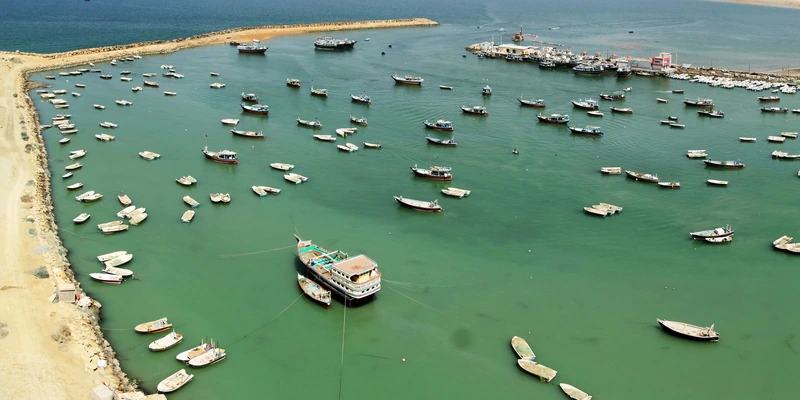
Southwards, Chabahar and the Sea of Oman shift attention to port life, eroded cliffs and the coast. Baluch embroidery and tabaheg add details beyond the scenery. Long distances mean each region deserves time; a considered route makes the province’s contrasting settings easier to appreciate.
05
Look for a city’s organisation rather than a standing skyline at Shahr-e Sukhteh. Residential and craft quarters, a cemetery and diverse finds reveal how an ancient Sistan urban society lived during the third millennium BCE.
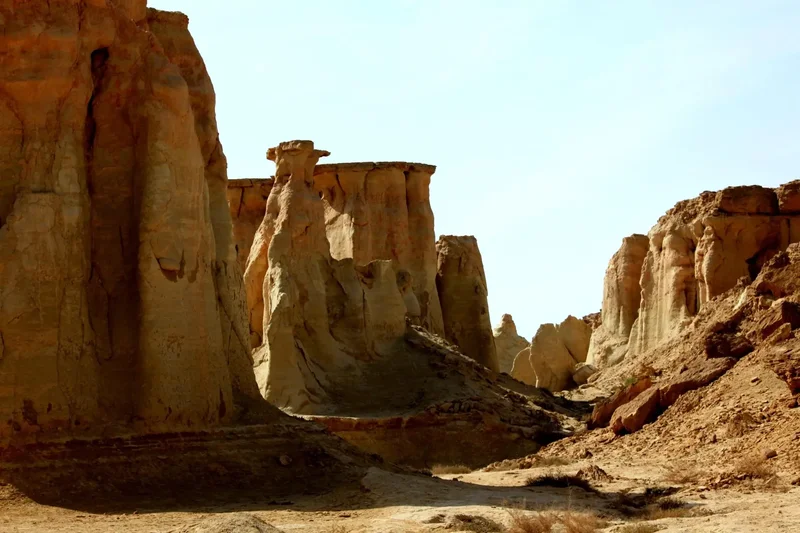
Grey-white ridges interrupt the blue sea along the Chabahar–Gwadar Bay road. The Martian Mountains draw attention to erosion: sharp grooves and rippling forms make the coast a place to study land as closely as water.
Rocky headlands and sandy coves meet an open Gulf of Oman horizon along the Chabahar coast. Spend time with the changing light and tide: the Makran shoreline’s shapes are as absorbing as the sea itself.
Lipar’s colour is a changing condition, not a fixed promise. Near Chabahar, algae and salt-loving microorganisms can lend saline water a pink tone, whose intensity shifts with water levels, salinity and the season.
River channels and natural pools are the focus in Gando Protected Area. This southeastern conservation landscape safeguards mugger crocodile habitat; its travel value is ecological understanding, with visits governed by conservation rules and local safety guidance.
Needlework is a distinctive feature of Baluch clothing, with different embroidery practices across the province. Literature, music and handicrafts make the cultural distinctions between Sistan and Baluchestan visible in everyday life.
Kuh-e Khwaja in Sistan, Iranshahr’s Naseri Castle and Tis near Chabahar are other historic places, presented separately from individually inscribed World Heritage properties.