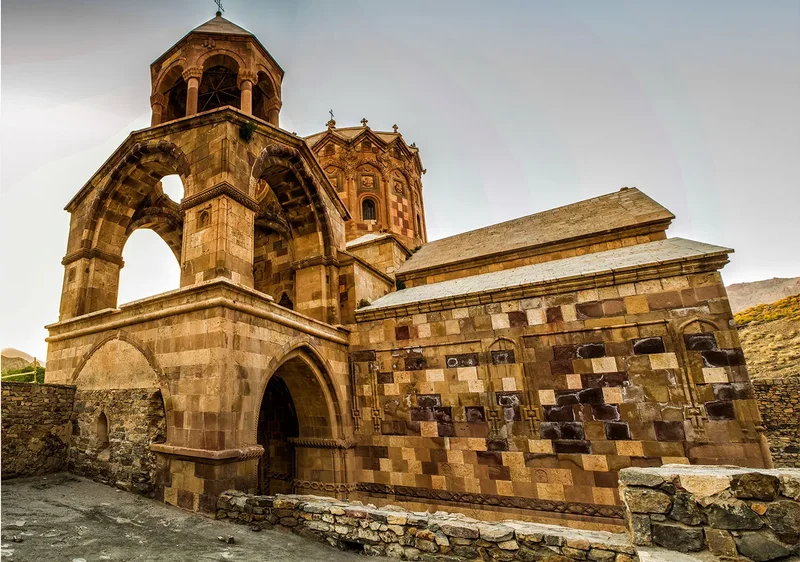
Qara Kelisa
Dark and pale stone give St Thaddeus a striking presence in north-western Iran. Its carved façades and continuing annual pilgrimage make Qara Kelisa a place to encounter Armenian religious memory as well as church architecture.
Northwest Iran, Lake Urmia and border highlands
Armenian monasteries and the legacy of Takht-e Soleyman
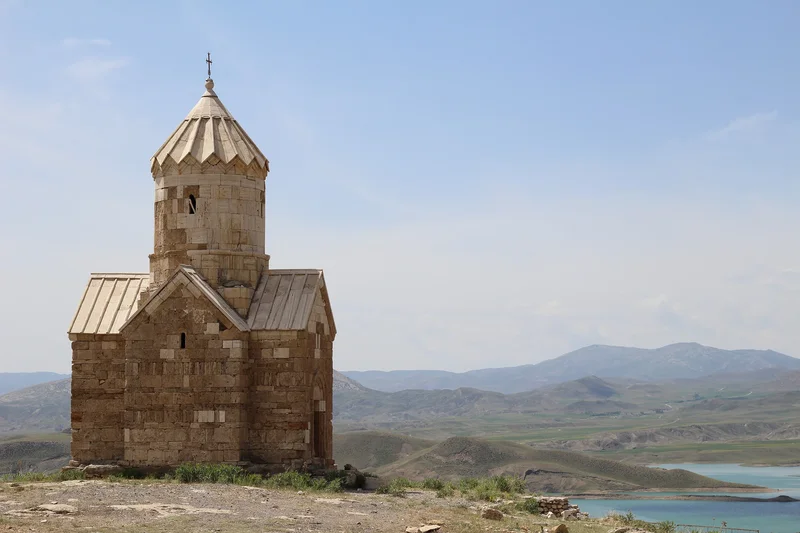
At Takht-e Soleyman, an artesian lake and Sasanian remains share an oval platform amid volcanic mountains. St. Thaddeus Monastery and Dzordzor Chapel provide different settings for exploring West Azerbaijan’s religious heritage. Together, these stops introduce several traditions through their surviving buildings and landscapes.
Make time for Urmia and Khoy’s markets between monument visits, then continue towards the rocky valley around Maku or the mountains near Takab. Lake Urmia is an environmentally vulnerable part of the route: changing water levels affect its appearance, so the scene may differ greatly from older photographs.
05
Dark and pale stone give St Thaddeus a striking presence in north-western Iran. Its carved façades and continuing annual pilgrimage make Qara Kelisa a place to encounter Armenian religious memory as well as church architecture.
Water, salt and islands define Lake Urmia’s changing horizon. This vulnerable northwestern lake is best approached as a shifting landscape, with its appearance tied closely to water levels and ecological conditions.
An artesian lake sits within the sacred architecture of Takht-e Soleyman. Against volcanic mountains, the oval platform brings Sasanian royal buildings and Zoroastrian worship into one unusually legible landscape.
Brick-covered lanes draw you into Urmia’s commercial heart. Caravanserais and craft sections give the market depth, recalling the city’s connections along routes between Iran, Anatolia and the Caucasus.
In Khoy, poetic memory meets an unusual brick tower decorated with ram horns. The mausoleum attributed to Shams Tabrizi joins Sufi associations with a striking trace of Safavid royal taste.
Turkic-speaking, Kurdish and Christian communities share parts of the province, contributing to varied local traditions. Markets, mosques and churches offer different perspectives on this cultural and religious heritage.
Urmia’s Seh Gonbad tower and the Shams Tabrizi monument in Khoy are other historic visits, separate from the World Heritage properties.